
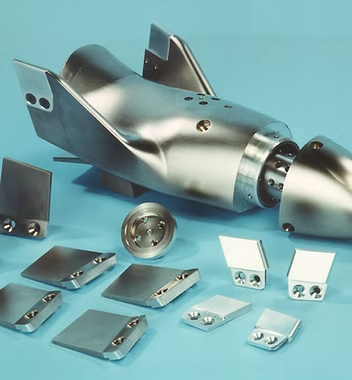
In order to protect the surface of a design model against particles with high kinetic energy, it is chemically nickel-plated with the DURNI-COAT® process (DNC). The protective layer on the outer skin of a demonstrator in the supersonic wind channel has a thickness of 30 m.
To protect the surface of a design model against particles of high kinetic energy, it is chemically nickel plated using the DURNI-COAT® process (DNC). The protective layer on the outer skin of a demonstrator in a super- sonic wind tunnel has a thickness of 30 μm.
The DURNI-COATR process consists in electroless deposition without any external source of electric- ity. In this process the workpiece is immersed into an aqueous process solution with a specific con- tent of nickel ions. During the process these ions are reduced into metallic nickel. The chemical re- acting agents and formulators of the electrons re- quired in this process are the hypophosphite ions in the solution. These agents are transformed, by oxidation in the course of the reaction, into ortho- phosphate. A nickel-phosphorus alloy layer forms on the work piece’s surface. This layer effectively protects the workpiece against wear and corro- sion. By variation of the electrolyte and process
131
parameters the layer’s properties may be customized to specific applications. Prior to the surface treatment an accurate coverage of the cast body’s interior, the tolerance dimensions of the control tabs by a special masking lacquer or tape is required. Covered areas will not be coated during the dipping of the parts into the nickel-electrolyte. After the treatment the coverage may be removed without problems. In spite of an in- creased number of examinations the chemically nickel plated surface resisted very good to the impositions in the wind tunnel.
PLIKI