
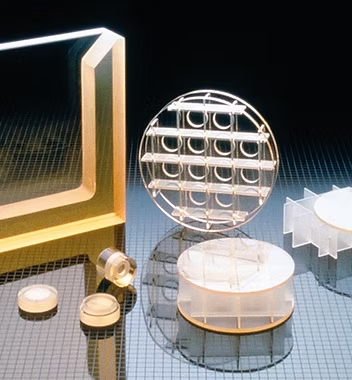
The segmented X-ray mirrors of the planned giant space telescope XEUS (X-Ray Evolving Uni-verse Spectroscopy) are no longer to be individually polished, but manufactured using an automated molding process. The challenges here lie in the required significant increase in impression accuracy. For the die, this means that it must maintain its shape and surface quality extremely accurately over a wide temperature range and that its thermal expansion
must be well matched to that of the glass to be formed with it. A new mold material for high-temperature processes was therefore needed for the production of several thousand precision glass substrates.
The new glass ceramic developed for this purpose is produced by thermal conversion of a semi-transparent starting material. Over 90% of the material is then in the crystalline phase with a keatite crystal structure.
As a result of the conversion process, the material is thermally stable and does not change even over many heating cycles. In long-term use, the glass-ceramic is characterized by a temperature resistance of up to 850°C. The thermal expansion is a low 2.0-10-6 K-1 in the range 20 – 700°C, and at room temperature even a value of only 1.5-10-6 K-1 is achieved.
PLIKI