
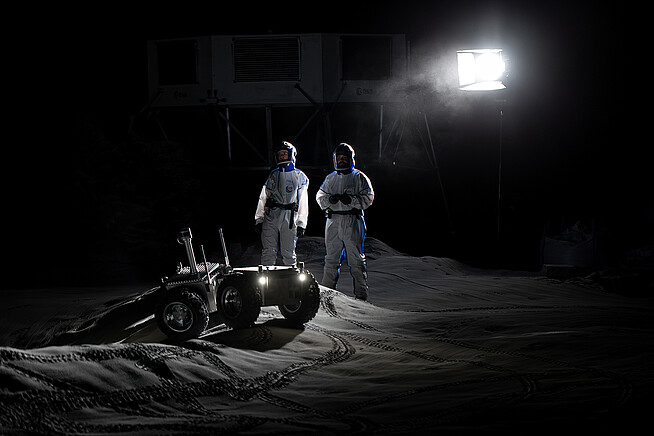
A modular dual use UGV platform developed by GSI GmbH with strong space heritage. The vehicle was built for the DLR Explorer Initiative and funded by the German Space Agency as a technology platform for future planetary surface missions. In that context, the rover was conceived to support swarm robotics concepts for Mars, including prospective multi rover operations in the Valles Marineris region, where high agility, robustness, and modular payload capability are essential. Building on the current development status, the platform is now being advanced towards dual use operations with scalable mission configurations and a system architecture prepared for later autonomous operation.
Problem statement
Conventional ground based exploration and operational vehicles are either highly specialized or limited in mobility, modularity, and operational flexibility. At the same time, demand is increasing for unmanned, highly mobile ground vehicles that can be used in civilian settings and in security relevant scenarios without directly endangering personnel. Especially in hazardous, hard to access, or contested areas, compact systems are lacking that combine high speed, robust design, and modular mission capability.
Solution
The rover platform developed by GSI GmbH provides a scalable technological basis for a future dual use UGV. The vehicle is currently remote controlled, while the architecture has already been systematically prepared for later autonomous operation. The system enables the integration of autonomy and assistance functions without fundamental structural changes to the platform. For security relevant applications, further structural and external hardening is planned, including a lightweight ballistic protection structure, for example based on Hardox steels, as well as ballistic resistant tires, adaptable to the specific scenario.
Standard
- Internal development platform of GSI GmbH
- Dual use approach for civil and security relevant operations
- Very high agility and speed for a UGV
- Modular architecture for different mission profiles
- Prepared for autonomous operation
- Low weight with high structural robustness
- Scalable drive concept
- Operable in extreme environments
Options
Planned extensions and future configurations under development, not production ready and requiring additional engineering and design work on the existing platform.
- Transport of injured persons and unmanned extraction from hazardous zones, concept and system level
- Troop and logistics support, transport of equipment and supplies, plus assistance and autonomy features such as obstacle detection, path planning, and person following
- Reconnaissance and sensing, integration of daylight and infrared cameras plus additional detection systems, optional laser marker, optional reconnaissance drone deployable from covered position
- Armed configuration as a conceivable escalation stage, requiring extensive technical, legal, and safety relevant development work
Customised solutions
- Mission specific payload integration and mechanical adaptations
- Autonomy and assistance feature integration aligned to the target use case
- Structural hardening packages including protective structure and tire concepts tailored to scenario
- needs
Innovative aspects
Agility and mobility
The platform targets a significant increase in agility, speed, and maneuverability compared to conventional exploration rovers by using a novel drive concept.
Scalability and modularity
A scalable rover platform concept enables different sizes and mission configurations and supports modular mission payloads.
Autonomy readiness by design
Remote control is available today, while the architecture is already prepared for later autonomous operation without fundamental changes to the platform structure.
Field oriented robustness
Outdoor operation on rough terrain and in wet conditions indicates practical suitability for harsh environments as a development platform.
Application areas
Space and analog exploration
- Civil exploration and research, planetary rover concepts and analog field campaigns
Security relevant use cases, prospective
- Logistics and support missions
- Reconnaissance and surveillance
- Evacuation and rescue operations
- Critical infrastructure inspection, energy, rail, pipelines, flood defenses, dams, solar parks, wind farms
- Industrial site inspection and safety support, chemical plants, refineries, hazardous outdoor zones, remote measurement
- Civil protection and disaster response, wildfire perimeter reconnaissance, flood zones, landslides, debris fields, storm damage assessment
- Search and rescue support, first look reconnaissance, delivery of small payloads such as medical supplies, ropes, radios, sensors
- Environmental monitoring, water sampling support, soil sampling support, methane and leak detection payloads, contamination mapping
- Mining and quarries, slope monitoring, haul road inspection, hazardous area reconnaissance
- Agriculture and forestry, field scouting, pest and disease mapping, forestry track inspection, post storm inspection
- Arctic and cold region operations, snow and ice monitoring, remote sensor deployment and retrieval
Cooperation
Type of partner sought
- Industrial partners and operators of infrastructure
- Civil protection organizations and security stakeholders
- Research and development institutions
Specific area of partner activity
- Field trials and pilot deployments
- Payload co development and integration
- Operational feedback and requirement definition for further development
Task to be performed
- Define pilot missions and requirements
- Perform field testing and iterative improvement
- Support transition from development platform to application specific system variants